Reviewed by Sahil Chopra, MD.
Research by Savit Malhotra
Introduction
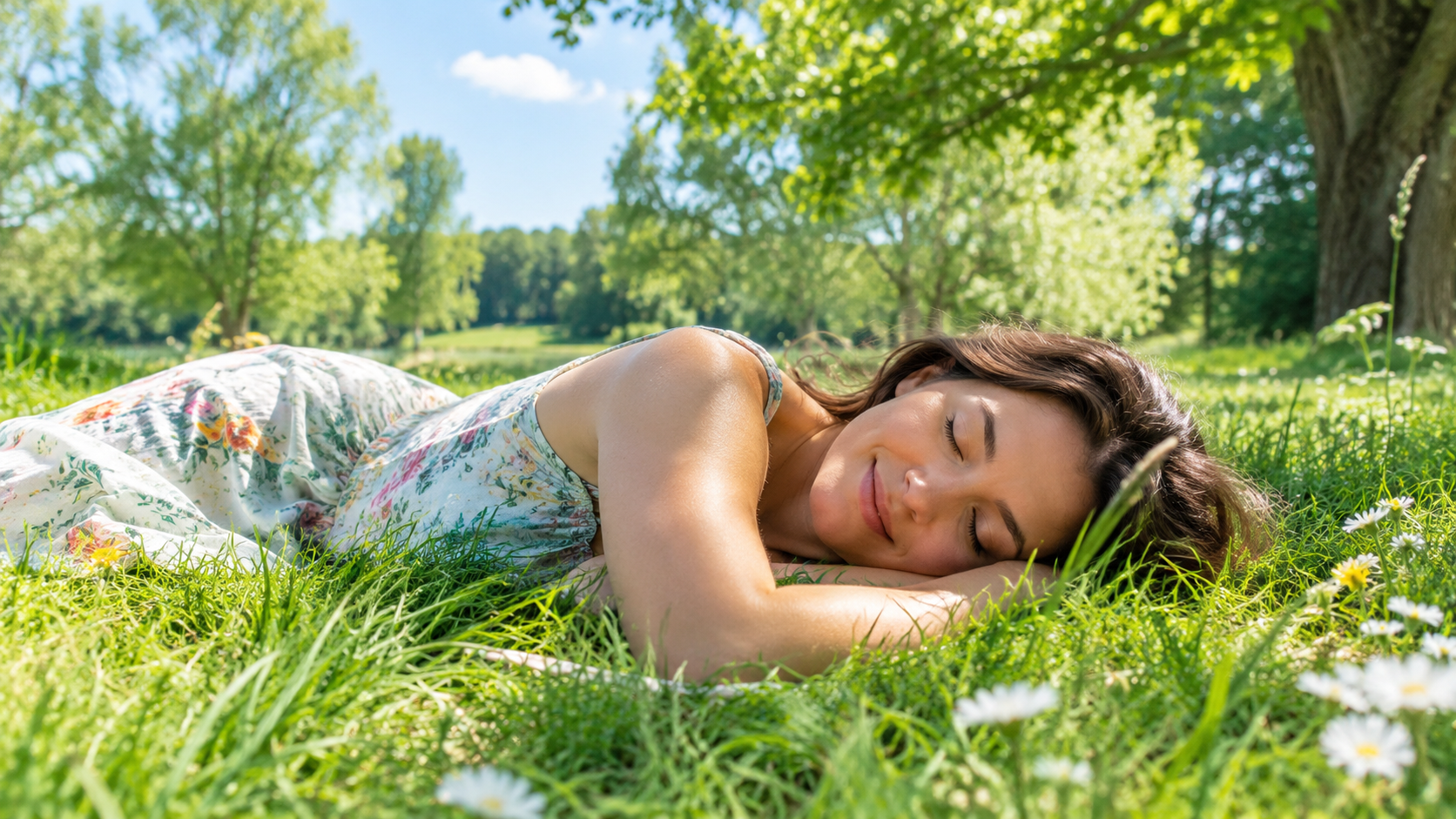
When we think about creating the perfect environment for sleep, we usually focus on what happens inside the bedroom: keeping it dark, quiet, cool, and comfortable. But what about the environment outside your window? Growing research suggests that the amount of nature surrounding us, from neighborhood trees and gardens to parks and forests, may also be connected to how well we sleep. Studies have associated greater exposure to green space with fewer sleep difficulties, longer sleep duration, and a lower likelihood of insufficient sleep, although these relationships are not consistent across every study.[1,2,3,4] Rather than acting as a direct sleep treatment, green spaces may influence sleep through several pathways, including stress reduction, physical activity, exposure to environmental light, and protection from heat and noise.
What Do We Mean by “Green Space”?
At first glance, green space sounds simple: somewhere with plants. In research, however, the term can encompass a surprisingly wide range of environments. The World Health Organization notes that there is no single universally accepted definition of urban green space. Depending on the study, it can include public parks, forests, gardens, street trees, grassy areas, playgrounds, residential yards, and other areas containing substantial vegetation.[1] Researchers may measure green space using satellite imagery, land-use databases, tree-canopy coverage, the percentage of vegetation surrounding a home, or even what people can see from their windows.
This distinction matters because having a park nearby, seeing trees from your bedroom, and actually spending an afternoon walking through a park are three different kinds of exposure. A neighborhood may look extremely green on a satellite image while the residents rarely use those spaces. Conversely, someone living in a dense neighborhood may routinely visit a large park even if there is relatively little vegetation immediately surrounding their home. Newer studies are beginning to examine these different types of exposure separately rather than treating all greenery as the same.[3,5]

Does Living Around More Green Space Actually Improve Sleep?
Overall, the research points toward a possible connection. A 2020 systematic review examined 13 studies investigating green-space exposure and sleep. Eleven reported an association between greater exposure to green space and improvements in sleep quality, sleep quantity, or both.[2] However, many of the studies relied on self-reported sleep and observational designs, meaning they could identify relationships but could not establish that green space itself caused people to sleep better.
Larger longitudinal studies have provided additional evidence. In a Swedish population-based cohort of 19,375 adults, researchers used detailed geographic data to measure vegetation at different distances from participants' homes. Greater green space within approximately 50 to 100 meters of the home was associated with fewer sleep difficulties even after accounting for demographic, socioeconomic, lifestyle, and urban factors.[3] Interestingly, green spaces farther from home were more strongly associated with better sleep among people who were physically active, suggesting that simply having nature somewhere nearby may not be as important as actually being exposed to or using it.
A separate Australian longitudinal study followed 38,982 adults and looked at different types of vegetation surrounding their neighborhoods. Greater overall green space, and particularly tree canopy, was associated with lower odds of insufficient sleep, defined in the study as sleeping fewer than six hours per day.[4] The authors were careful to describe these as associations rather than proof that planting trees would automatically make residents sleep longer.
Seeing Nature vs. Actually Spending Time in It
One of the more interesting recent studies suggests that how we experience nature may matter as much as how much nature surrounds us. In 2024, researchers analyzed survey data from 16,077 adults across 18 countries and compared six types of nature exposure, including neighborhood green space, greenery visible from home, proximity to the coast, and visits to green or blue spaces.[5]
Simply having more green space within one kilometer of home was not significantly associated with a lower likelihood of insufficient sleep after the researchers adjusted for other factors. In contrast, seeing greenery from home and recreationally visiting green or blue spaces were associated with a lower likelihood of sleeping fewer than six hours. The researchers also found that better mental well-being appeared to help explain some of the relationship between nature exposure and sleep.[5] This does not prove that a walk through the park will cure insomnia, but it suggests that exposure and interaction may be more meaningful than the number of trees appearing on a map.

How Could Green Space Affect Sleep?
There probably is not one single mechanism. Researchers generally describe several overlapping pathways through which green environments could influence health and sleep. One framework divides them into three broad categories: reducing harmful environmental exposures, restoring psychological resources, and encouraging healthy behaviors.[6]
- Less Stress Before Bed - Stress and mental well-being are likely part of the picture. Natural environments have been associated with psychological restoration and reductions in perceived stress, while the large 18-country study found that better mental well-being statistically mediated some of the association between nature visits and adequate sleep.[5,6] If spending time outdoors helps someone decompress, it may indirectly make it easier to transition into sleep later in the evening. However, this pathway remains difficult to separate from other factors such as exercise, socioeconomic conditions, and neighborhood quality.
- More Opportunities to Be Active - Parks, trails, gardens, and tree-lined neighborhoods also provide places to walk, run, cycle, or simply spend more time moving. This matters because physical activity itself is associated with better sleep. The CDC notes that regular physical activity can improve sleep quality, while greater amounts of moderate-to-vigorous activity have been associated with improvements in sleep efficiency and sleep onset.[7] Green space therefore may sometimes benefit sleep not because vegetation has a special sedating effect, but because it creates an environment where healthy daytime behaviors are easier or more enjoyable.
- Cooler Neighborhoods on Hot Nights - Green space may also change the physical environment surrounding a home. Trees provide shade, while vegetation releases water into the atmosphere through evapotranspiration, helping reduce local temperatures.[8] This can become particularly important during summer heat events, when urban pavement and buildings retain heat well into the night. A 2024 study of 584 people examined green space, perceived heat stress, and sleep during both heat events and more typical summer conditions. During heat events, greater tree cover was associated with less perceived heat stress, while greater grass and shrub cover was associated with both lower heat stress and better reported sleep quality.[9] The results do not establish that vegetation directly improved sleep, but they highlight an intriguing connection between two topics in this environmental sleep series: green space may partly protect sleep by making hot urban environments more tolerable.
- Potential Protection From Noise and Other Environment Stressors - Vegetation and thoughtfully designed green spaces may also influence exposure to environmental stressors such as noise and air pollution, although these relationships are complicated and depend heavily on the layout of a neighborhood and the type of vegetation. WHO identifies reduced exposure to excessive heat, noise, and certain air pollutants as possible health pathways associated with urban green spaces.[1] These are particularly interesting for sleep because each of those exposures, heat, environmental noise, and poor air quality, can independently interfere with nighttime rest. This also shows why it is difficult to isolate a single “green-space effect.” A tree-lined neighborhood may simultaneously be cooler, quieter, more walkable, less stressful, and farther from major traffic corridors. Researchers therefore have to account for many environmental and social factors when trying to determine whether greenery itself is responsible for differences in sleep.
Is More Green Space Always Better?
Not necessarily, and this is especially relevant after discussing seasonal allergies. Green spaces can offer numerous environmental and health benefits, but certain plants also release allergenic pollen. A 2025 clinical review noted that urban greening strategies need to balance the benefits of vegetation with the possibility of increasing pollen exposure, particularly when cities rely heavily on wind-pollinated species such as certain grasses and trees.[10] That means the type and design of green space matter, not merely the amount. For someone with severe seasonal allergic rhinitis, spending hours around a particular pollen trigger during peak season could worsen congestion and potentially make sleep more difficult, even though green space may offer benefits through other pathways. Researchers and urban planners are increasingly interested in designing greener cities while choosing diverse, lower-allergen vegetation where possible.[10]
There are other limitations as well. Parks that feel unsafe or inaccessible are unlikely to encourage evening walks or relaxation, and people with higher incomes may both live in greener neighborhoods and have other advantages that support healthier sleep. These factors help explain why newer reviews still describe the overall evidence linking green space specifically to sleep as mixed rather than conclusive.[11]

How Can You Use Nature to Support Better Sleep?
You probably do not need to move next to a forest to take advantage of the potential benefits. Instead, think of nature as one component of a healthy daytime routine. Spending time outside, walking through a park, exercising on a tree-lined trail, gardening, or simply taking breaks outdoors can combine several sleep-supporting behaviors at once: physical activity, daylight exposure, relaxation, and separation from indoor screens and work environments. The National Heart, Lung, and Blood Institute recommends spending time outside when possible and being physically active as part of healthy sleep habits.[12]
And based on current research, actually interacting with natural environments may be more useful than simply living near them.[5] A short daytime walk through a neighborhood park is not a treatment for chronic insomnia or another sleep disorder, but it is a low-risk way to combine nature exposure with movement and outdoor light. People with pollen allergies may want to check local allergen levels and choose the timing or location of outdoor activity accordingly.
Most importantly, green space should be viewed as a potential support for healthy sleep, not a substitute for established sleep habits or medical treatment. Persistent difficulty falling asleep, staying asleep, excessive daytime sleepiness, loud snoring, or suspected sleep apnea deserves appropriate evaluation regardless of how green your neighborhood happens to be.
Conclusion
The environment affecting your sleep extends well beyond the four walls of your bedroom. Research suggests that living near, seeing, and, perhaps most importantly, spending time in green spaces may be associated with healthier sleep. The relationship could involve several pathways at once, including lower stress, greater physical activity, reduced heat exposure, and improvements in the broader neighborhood environment.[3,4,5,6] At the same time, most of the evidence remains observational, and newer reviews emphasize that the relationship between greenery and sleep is not yet completely understood.[11]
So, does spending time in nature guarantee a better night's sleep? No. But a walk through the park, an afternoon in the garden, or even a view of trees outside your window may be doing more than making your surroundings look nicer. When combined with regular physical activity, daytime outdoor exposure, and good sleep habits, a little more nature may be one more way the environment can help support a healthier night.


.png)
.png)