Reviewed by Sahil Chopra, MD.
Research by Savit Malhotra and Quynh Theresa Do.
Introduction
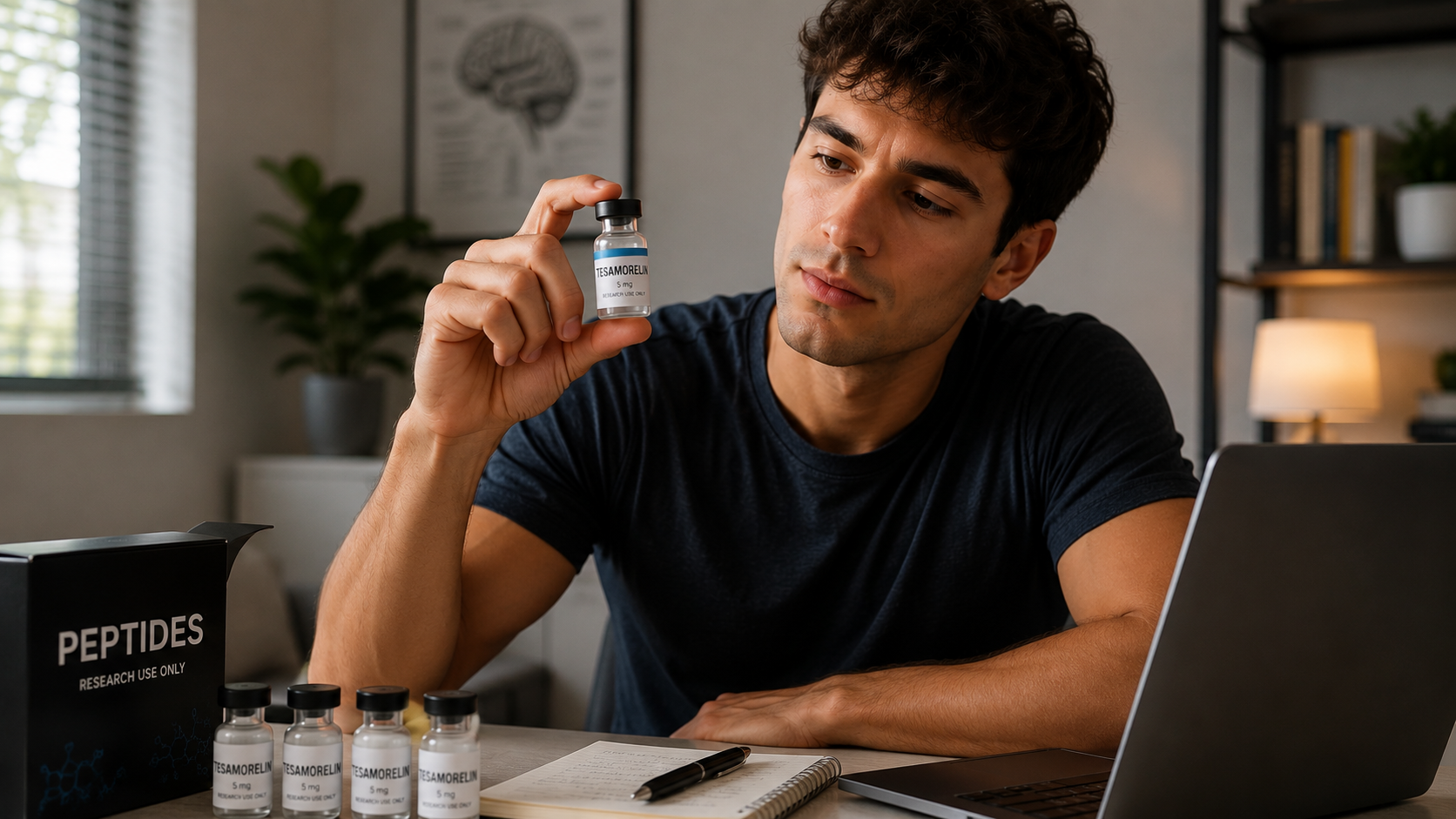
As we continue discussing the numerous peptides gaining attention in the media, we will now focus on sermorelin. Sermorelin, a growth hormone-releasing hormone (GHRH) analog, is a synthetic peptide that works by stimulating the pituitary gland and the production of growth hormone. This mechanism of action is similar to tesamorelin, which we discussed in a previous article. However, it is important to note that while these two peptides have similar mechanisms, they do not have the same medical purpose or approvals. Originally, sermorelin was meant to help overall well-being by promoting body composition (helping to aid weight management and increase lean muscle mass), recovery, and improving sleep quality (which will be our main focus). Typically, sermorelin is generally considered to be safe and well-tolerated. However, there is no currently available commercial version of sermorelin that is FDA-approved (we will discuss this more in the next paragraph), meaning that sermorelin can only be legally obtained from licensed compounding pharmacies as a customized medication. For this reason, we do not recommend that someone begin taking sermorelin before consulting with a medical professional. In this article, we will work to give an overview of the peptide (including its history, mechanism, and what the current research says) so that our readers can better understand this peptide and its functions.
The History of Sermorelin
GHRH was first documented to have been discovered in 1982 with the isolation of three isoforms (1-37, 1-40, and 1-44 aa residues) in human pancreatic tumors.[1] The discovery of these isoforms led to GHRH being identified in various vertebrates and, eventually, the development of several GHRH peptides.[1] Sermorelin (also known as GHRH/GRF (1-29) after its 29-amino acid polypeptide chain) was first patented in 1990 by the manufacturer EMD Serono.[2]*see note* While some forums document that early clinical trials of the peptide began in the 1990s, this too could not be verified through reliable sources. Most published studies still available online occurred after 1997 and were short-term, with there being minimal long-term follow-up studies. However, what can be verified is that the peptide did not gain FDA approval until 1997, originally as a treatment for children with delayed growth.[3] Initial findings were promising because sermorelin was able to stimulate growth hormone secretion from the pituitary gland without affecting other hormones (such as insulin, glucose, cortisol, and thyroid hormones, among others).[2,3,4] Aside from being prescribed as a therapy for growth failure, sermorelin was also used as a means of diagnosing growth hormone deficiencies.[5] Later on, practitioners in the field of longevity medicine began to propose its usage to aid in healthy aging.[6] The hypothesis was that, since naturally occurring GHRH activity declined with age, sermorelin could help restore activity better than alternatives (such as recombinant human growth hormone (rhGH) or growth hormone replacement therapy (GHRT)).[7] However, this hypothesis could never be tested.

In 2008, EMD Serono pulled Geref (their brand name for sermorelin) from the market.[8] The reason was not because of safety concerns or lack of efficacy (which was confirmed by the FDA), but rather strictly because of business reasons.[8] In the late 1990s and early 2000s, sermorelin was still being utilized, but clinical preferences shifted toward rhGH. The company simply could not justify the costs of producing sermorelin and wrote an official letter to the FDA asking for their approval to be withdrawn and their product to be moved to the “Discontinued Drug Product List.”[8] Since then, no other product has gained FDA approval. While sermorelin can be obtained through compounding pharmacies that make individualized medications, there is no mass-produced, commercially available sermorelin available in the United States.[9] Despite this, sermorelin has gained attention recently among the longevity and wellness space once again.
*Note: Some online forums state that sermorelin was first developed in the 1980s, but we were unable to find a reliable source to corroborate these claims.
How Does Sermorelin Work?
As mentioned earlier, Sermorelin mimics the action of GHRH, similar to tesamorelin. After administration (usually through an injection), Sermorelin binds on the pituitary gland, stimulating the release of growth hormone. Once released, growth hormone promotes the production of insulin-like growth factor-1 (IgF-1), primarily in the liver.[10] Together, growth hormone and IGF-1 help regulate muscle growth, tissue repair, fat metabolism, and many other physiological processes. Unlike direct growth hormone therapy, Sermorelin relies on the body's normal regulatory systems, meaning growth hormone release remains influenced by natural feedback mechanisms.[11] However, Sermorelin has a short half-life in the blood (roughly 10 to 20 minutes), which limits how long it remains active after each dose.[13]

What Does the Research Say About Sermorelin for Sleep?
Although Sermorelin has been studied for several decades, relatively little research has focused specifically on sleep outcomes. Sermorelin instead has been studied for other conditions, such as for diagnostic use and to treat idiopathic growth hormone deficiency in children.[14] Most clinical studies on Sermorelin have evaluated hormone regulation or growth hormone deficiency rather than insomnia or sleep quality.[11] Importantly, the studies that have examined GHRH and sleep used various formulations, doses, and routes of administration. They also did not use Sermorelin specifically.[15] Like tesamorelin, because Sermorelin is a synthetic form of GHRH, researchers have questioned whether it may improve sleep quality. There is evidence on GHRH’s effects on sleep. In healthy young volunteers, episodic intravenous GHRH administration enhanced slow-wave sleep and reduced time spent awake.[16] However, several other studies report no effects on sleep from GHRH.[17] As a result, there is currently insufficient evidence to conclude that Sermorelin directly improves sleep in healthy adults or individuals with insomnia. Further research is needed to determine whether Sermorelin meaningfully improves sleep quality, recovery, or healthy aging in adults without growth hormone deficiency.
Conclusion
Like many peptides in the market, Sermorelin is not currently FDA-approved and should be used with caution. Sermorelin has received positive feedback on online forums, but more clinical research must be conducted to fully understand the effects. While peptides such as Sermorelin continue to generate interest, optimizing sleep begins with evidence-based habits and identifying any underlying sleep disorders. At Empower Sleep, our at-home sleep testing and expert-guided care are designed to identify sleep disorders and provide personalized treatment recommendations, helping you achieve better sleep and improve your long-term health. Contact our team today for information on sleep, treatment, peptides, and more!


.png)
.png)