Reviewed by Sahil Chopra, MD.
Research by Savit Malhotra
Introduction
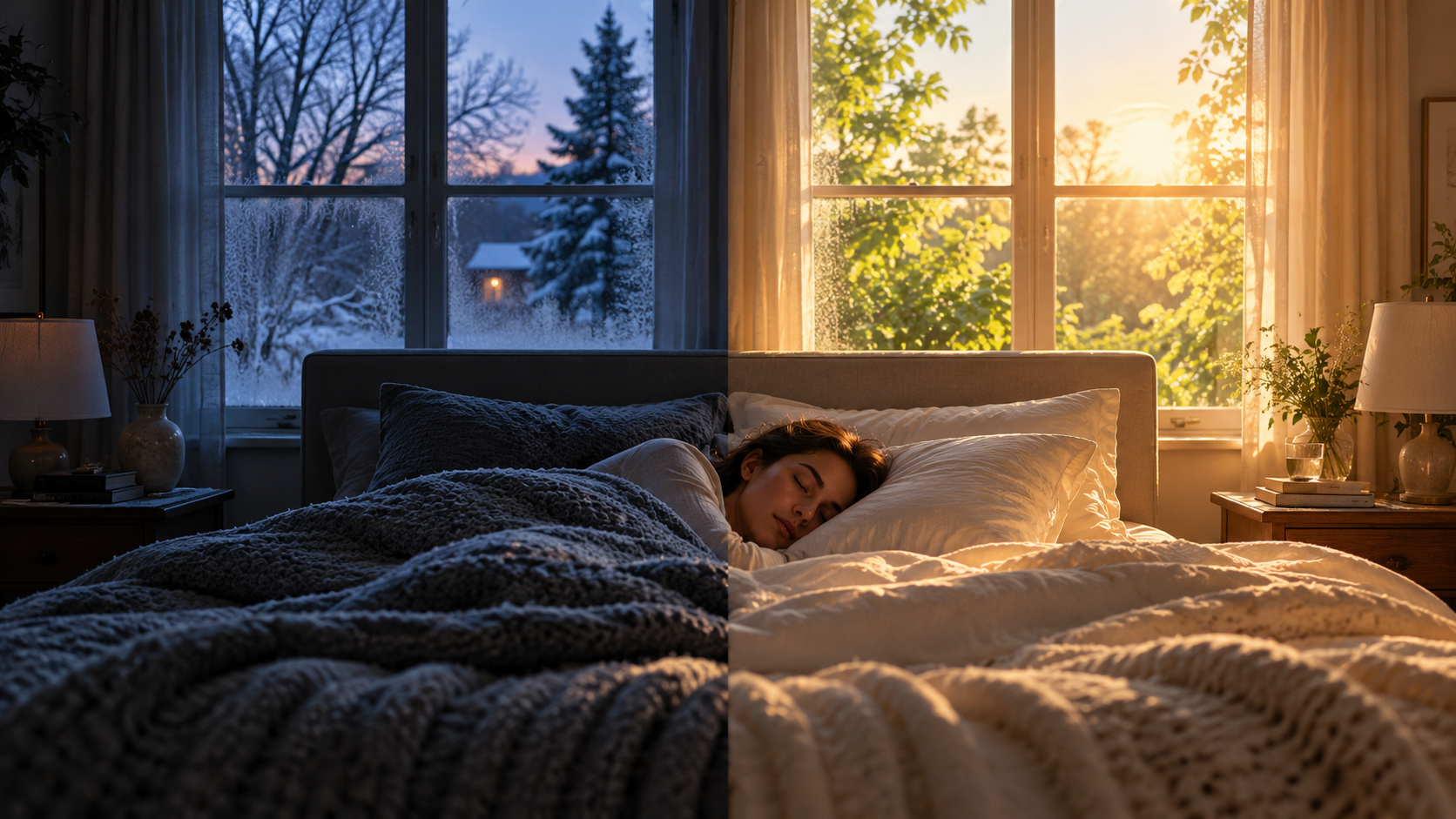
The environment around us changes dramatically throughout the year. Summer brings long evenings and early sunrises, while winter can mean waking before sunrise and watching the sun disappear before the workday is over. Although modern lighting allows us to largely ignore these changes, our biology has not completely forgotten them. Light is one of the strongest signals regulating the body's internal clock, helping determine when we feel awake, when we become sleepy, and when hormones such as melatonin rise and fall.[1,2,3,4,5]
Research suggests that sleep can change with the seasons, but the story is more complicated than simply “we sleep more in winter.” Some studies have found later sleep timing, greater sleepiness, and changes in sleep architecture during darker months, particularly at high latitudes.[6,7,8,9] Other large modern studies find only small seasonal changes in total sleep duration.[10] The most important factor may therefore be not the season itself, but when and how much light reaches us throughout the day.
How Does Light Control the Body Clock?
Deep within the brain is a small region called the suprachiasmatic nucleus, or SCN, which functions as the body's central circadian clock. This clock coordinates daily rhythms across the body, including sleep and wakefulness, hormone release, body temperature, metabolism, and alertness.[1] But the internal clock is not exactly 24 hours on its own. It needs environmental signals to stay synchronized with the outside world, and the most powerful of those signals is light. Specialized cells in the retina known as intrinsically photosensitive retinal ganglion cells, or ipRGCs, contain a light-sensitive pigment called melanopsin. Together with input from the rods and cones involved in vision, these cells transmit information about environmental light to the SCN.[2] The brain therefore uses light for more than seeing what is around us; it also uses light as information about what time of day it is.
One important result of this system involves melatonin. Melatonin levels normally increase during the evening as biological night begins and decrease toward morning. Bright light in the evening can suppress or delay this process, while appropriately timed morning light can shift circadian timing earlier.[1,3,4,5] That makes the timing of light just as important as its brightness.
Morning Light and Evening Light Do Different Things
Light does not have the same effect on the body clock at every hour of the day. Controlled laboratory experiments have mapped what researchers call the phase-response curve to light. In simple terms, light exposure during the biological evening and early part of the night generally tends to move the circadian clock later, while appropriately timed light later in the biological night and morning tends to move it earlier.[3,4] One classic experiment found that a single period of early-morning bright light shifted participants' melatonin rhythms earlier within a day.[4] Larger phase-response studies later confirmed that the timing of light exposure determines both the direction and magnitude of the circadian shift.[3] This helps explain why seasonal daylight changes can matter.
During winter, sunrise occurs later. For someone who wakes early for work or school, much of the morning routine may take place in darkness, reducing exposure to one of the strongest signals that normally helps anchor the circadian system earlier. Summer presents almost the opposite situation. Earlier sunrises can provide more morning light, but long evenings also expose us to light later in the day. At sufficiently high latitudes, sunset may occur very late, or darkness may barely arrive at all. Whether the net result shifts sleep earlier or later depends on the timing of exposure, personal schedules, latitude, indoor lighting, and individual circadian biology.
Does Our Sleep Actually Change With the Seasons?
There is evidence that it can, although results vary substantially between studies. One early controlled study followed 10 healthy men across all four seasons. Researchers found that nocturnal sleep occurred approximately 90 minutes later in winter than in summer. REM sleep increased during winter, while stage 4 sleep decreased.[6] The sample was very small, so those exact numbers should not be generalized broadly, but the study provided early evidence that human sleep may retain some seasonality even under modern living conditions.
More recently, researchers examined overnight polysomnography from 188 patients at a neuropsychiatric sleep clinic in Germany.[8] REM sleep was approximately 30 minutes longer in winter than in spring, while REM latency and slow-wave sleep also showed seasonal patterns. Total sleep time appeared longer in winter than in summer by as much as about an hour, although that particular difference did not reach statistical significance.[8] Because these participants were patients being evaluated for sleep or neuropsychiatric conditions rather than a healthy population, the findings need replication before being applied to everyone.
A 2026 study using 2,386 home sleep recordings also identified seasonal variation in several sleep, respiratory, and cardiovascular measures. Sleep latency was longest in summer and shortest in fall, while respiratory and oxygenation measures showed additional seasonal differences.[9] However, because each person contributed only one study and different people were measured in different seasons, the study cannot prove that the seasons themselves caused those changes. So there appears to be some seasonal signal, but its size and meaning depend heavily on the population being studied.
Winter May Shift Sleep Later, Not Necessarily Make Us Sleep Longer
One of the clearest demonstrations of seasonal daylight effects comes from places where the difference between summer and winter daylight is extreme. Researchers followed 32 daytime office workers in Kiruna, Sweden, located nearly 68 degrees north of the equator.[7] The same workers were monitored during a summer week and a winter week. In winter, sleep onset occurred approximately 39 minutes later than in summer. The midpoint of sleep was also later, about 25 minutes later on workdays and 46 minutes later on days off, and participants reported greater winter sleepiness.[7]
Morning light exposure was associated with earlier sleep timing, while greater evening light exposure was associated with later sleep timing. Interestingly, participants actually slept about 12 minutes less per weeknight in winter rather than dramatically longer.[7] This distinction matters. The common idea that darker winter days simply cause people to sleep for much longer may be too simplistic. Reduced morning daylight may instead make the body's circadian timing drift later, even though work and school schedules still require waking at roughly the same clock time. That combination can create a mismatch: your internal clock wants a later morning, but your alarm clock does not care what season it is.
Modern Life May Be Flattening Our Seasonal Rhythms
If human biology responds to seasonal light, why don't everyone's sleeping habits change dramatically between July and January? Modern life may be part of the answer. Most people in industrialized societies spend large portions of the day indoors. Work, school, heating, air conditioning, artificial lighting, alarm clocks, and fixed schedules allow us to maintain relatively similar routines regardless of when the sun rises or sets. A small study of full-time office workers found remarkably little seasonal change in sleep and circadian timing.[11] Participants maintained similar sleep, commuting, and working schedules during summer and winter, generally varying by less than 30 minutes. Their circadian melatonin timing also did not differ substantially between seasons.[11]
A much larger 2026 analysis provides an even stronger caution against exaggerating seasonal effects. Researchers analyzed self-reported sleep from 416,731 U.S. adults, representing a weighted population of approximately 259 million people.[10] Average reported sleep duration ranged from about 7.82 hours in April to 8.13 hours in January, but overall month-to-month variation was small and largely not statistically significant after analysis.[10] Geographic differences related to latitude and time zone were more consistent than seasonal differences. The study relied on self-reported sleep and measured different people rather than repeatedly following the same individuals throughout the year, so subtle within-person changes could have been missed. Still, it suggests that in modern U.S. life, season may have a relatively small effect on how many hours people report sleeping. Seasonal daylight may therefore affect when we sleep and how our circadian system is timed more consistently than it changes total sleep duration.

The Time You See Light May Matter More Than the Season
Real-world studies strengthen this idea. In one field study, researchers measured light exposure, circadian melatonin timing, and overnight sleep using polysomnography in healthy adults.[12] People exposed to light later in the day tended to have later circadian timing and later sleep. Later first exposure to meaningful daytime light was also associated with more awakenings during subsequent sleep.[12] This means two people living in the exact same city during the exact same season could experience very different light environments. One person might wake at 7 a.m., immediately open the curtains, walk outside to commute, eat lunch outdoors, and keep the lights relatively dim at night. Another could wake in a dark bedroom, drive to work before sunrise, spend the entire day inside a dim office, commute home after sunset, and then spend the evening surrounded by bright indoor lighting and screens. The calendar says both people experienced the same winter day. Their circadian systems may receive very different messages.
Why Morning Daylight Is Particularly Important
One practical lesson appears repeatedly throughout circadian research: getting light earlier in the day can help reinforce an earlier and more stable circadian phase. In the Arctic worker study, greater morning light exposure was associated with earlier sleep timing.[7] In a separate study of adolescents with an evening circadian preference, lower early-morning light exposure was associated with later sleep onset, later waking, and later sleep offset.[13] Later exposure to light was also associated with shorter sleep duration.[13]
Experimental work demonstrates that morning bright light can actively shift circadian timing earlier. In one study of adolescents with late bedtimes and short school-night sleep, appropriately timed morning bright-light exposure over a weekend produced measurable advances in circadian phase.[14] That does not mean everyone needs to buy a therapeutic light box or spend a precisely prescribed number of minutes staring toward the sunrise.
For most healthy people, a simpler strategy is to regularly get outside during the morning and daytime when possible, particularly during darker months. Outdoor light is typically far brighter than ordinary indoor lighting, even on cloudy days. The National Heart, Lung, and Blood Institute similarly recommends spending time outside during the day as part of healthy sleep habits.[18]
What About Long Summer Evenings?
Winter is not the only season that can challenge the body clock. During summer, especially at higher latitudes, daylight can continue late into the evening. Because evening light can shift circadian timing later, long summer evenings may encourage later biological and behavioral sleep timing. This does not mean sunset automatically determines bedtime. Artificial lighting, work schedules, social activity, screens, and personal habits often exert an even stronger influence.
However, experimental research shows that evening light can meaningfully affect the circadian system. In a controlled study examining light conditions comparable to those people encounter in homes, evening light altered melatonin and sleep timing, with effects depending partly on the spectral composition and the individual's sensitivity to light.[5] Summer also tends to bring behavioral changes: later social activities, vacations, outdoor dining, and less rigid schedules. That makes it difficult for researchers to separate the biological effects of longer daylight from the things people simply do differently during summer. This is one reason studies examining “season” alone can be hard to interpret.
Why Some People May Notice Seasonal Changes More Than Others
Seasonal changes are unlikely to affect everyone equally.
- People Living at Higher Latitudes
- Latitude produces one of the largest differences in seasonal daylight. Near the equator, day length changes relatively little throughout the year. Farther north or south, the difference can become dramatic. The Arctic worker study demonstrates how reduced winter daylight can noticeably delay sleep timing even among people working conventional daytime schedules.[7]
- People Who Spend Most of the Day Indoors
- A person can live through an entire bright summer day while receiving relatively little outdoor light if most of the day is spent inside. Office workers often receive much lower-intensity light than they would outdoors, meaning commuting, outdoor breaks, and morning routines can disproportionately influence daily light exposure.[11]
- Adolescents and Evening Types
- Adolescents naturally tend toward later circadian timing during puberty, and many already struggle to fall asleep early enough for morning obligations. Studies of adolescents with evening preferences show that both the timing and intensity of daily light exposure are associated with their sleep schedules.[13,14] People with a naturally late chronotype may therefore be particularly sensitive to a winter environment with little morning light or a summer environment with substantial evening light.
And Then We Change the Clocks
Seasonal changes in sunlight happen gradually. Daylight saving time changes happen overnight. During the spring transition to daylight saving time, clocks suddenly move forward by one hour. Sunrise and sunset then occur an hour later according to social clock time, producing darker mornings and brighter evenings compared with standard time.
A 2025 systematic review examined 27 studies involving people between 6 and 85 years old.[15] Overall, the transition to daylight saving time was associated with reductions in sleep duration and sleep quality and greater sleepiness, with more pronounced effects among people with evening chronotypes. However, results varied substantially between studies, and the authors emphasized methodological inconsistencies that limit definitive conclusions about the magnitude and duration of these effects.[15] This issue is different from the natural change in seasons. Seasonal daylight gradually shifts over weeks and months, giving the circadian system repeated opportunities to adjust. The spring clock change abruptly moves social schedules relative to solar time.
The American Academy of Sleep Medicine currently recommends eliminating seasonal clock changes in favor of permanent standard time, arguing that standard time aligns more closely with human circadian biology because it preserves relatively more morning light and less evening light.[16,17] This is the AASM's policy position; debates about clock policy also include economic, social, and recreational considerations beyond sleep science.
Does Seasonal Daylight Change REM Sleep?
One particularly interesting, and still unsettled, question is whether the seasons affect not only when we sleep, but the structure of sleep itself. The 1992 study of healthy adults found increased REM sleep during winter.[6] More than 30 years later, the German sleep-clinic study found a similar pattern: participants experienced approximately 30 additional minutes of REM sleep in winter compared with spring.[8] Those findings are intriguing because REM sleep is regulated partly by circadian timing. But they are not enough to conclude that everyone “needs more REM during winter.” One study contained only 10 healthy men, while the other analyzed people undergoing clinical sleep evaluation. Other environmental factors, including temperature, physical activity, illness, mood, and sleep duration, also vary by season. The most scientifically accurate conclusion is that seasonal variation in human sleep architecture is plausible and has been observed, but it is not yet established well enough to prescribe different seasonal sleep requirements.
How Can You Use Daylight to Support Better Sleep?
You cannot control when the sun rises, but you can influence when your body encounters light.
One of the simplest strategies is to seek daylight earlier in your waking day, particularly during winter when it may be easy to spend the entire morning under relatively dim indoor lighting. Opening blinds can help, but going outside generally provides much stronger light exposure.
Spending some time outdoors during the daytime can also strengthen the contrast between a bright day and a dark night, giving the circadian system a clearer environmental signal.[1,18] During the evening, the opposite principle applies. You do not need to live by candlelight as soon as the sun sets, but reducing unnecessary bright light close to bedtime can help avoid sending a strong daytime signal at the wrong biological time.[1,5,18]
Maintaining a reasonably consistent wake time can also help. Because waking determines when many people first encounter substantial light, large weekend shifts in wake time can also shift the timing of the light signal reaching the circadian system. If you struggle with persistent delayed sleep timing, severe seasonal mood symptoms, or another circadian sleep disorder, therapeutic bright-light treatment should be approached more carefully. The timing of bright light determines whether it moves the clock earlier or later,[3] so poorly timed treatment can have the opposite effect from what was intended. A sleep or healthcare professional can help determine appropriate timing when light is being used therapeutically rather than simply as normal daytime exposure.
The Goal Is Not to Chase a Perfect Number
It can be tempting to reduce light and sleep into rules. Get exactly this many minutes of sunlight. Reach exactly this number of lux. Go outside exactly this long after waking. But human circadian biology is not that simple. The biological effect of light depends on intensity, duration, wavelength, timing, previous light exposure, individual sensitivity, and circadian phase.[2,3,5] Two people standing outside at the same time can therefore respond somewhat differently.
For most people, the useful principle is simpler. Bright days. Darker evenings. Consistent timing. Get outside when possible, especially earlier in the day. Avoid spending every daylight hour in a dim indoor environment. Allow evening light exposure to gradually decrease as bedtime approaches. And keep sleep and wake times reasonably regular. These habits work with the environmental signals the circadian system evolved to interpret rather than attempting to micromanage them.
Conclusion
The seasons change more than the temperature outside. They also change one of the most powerful environmental signals reaching the human brain: light.
Research suggests that seasonal daylight can influence sleep timing, circadian phase, sleepiness, and possibly sleep architecture, particularly in places where daylight varies dramatically between summer and winter.[6,7,8,9] At the same time, large modern population studies show that total sleep duration does not necessarily change dramatically with the seasons.[10]
That apparent contradiction tells us something important. Humans still respond biologically to natural light, but modern life increasingly separates us from it. We wake to alarms rather than sunrise, spend our days beneath indoor lighting, and extend our evenings with artificial light long after sunset. The sun may no longer determine exactly when we go to bed, but it remains one of the strongest signals telling our bodies when day begins and when night should arrive. Sometimes supporting better sleep may be less about adding something new to the bedroom and more about reconnecting with the light-dark cycle happening outside it.


.png)
.png)